


Helping Aging Parents Sell a Lifetime Gun Collection

For many families throughout the Saint Louis area and across Missouri, the conversation starts with a simple realization, Mom and Dad are getting older.
The house may be getting too large. Retirement plans are taking shape. A move may be on the horizon. A parent may be moving into assisted living or memory care, or a dementia diagnosis may have changed what the family needs to consider. Or perhaps family members are simply beginning to think about how to reduce future responsibilities.
Then someone opens a safe, steps into a basement workshop, or begins looking through a collection that has been built over decades.
The question quickly becomes:
At MDRF Enterprises, we regularly work with families throughout the Saint Louis area who find themselves facing exactly this situation.
In many cases, the collector is still actively involved and wants to make decisions personally rather than leaving those responsibilities to family members later. Those conversations can be difficult, but they often create the best opportunity to preserve important information, understand value, and simplify future estate planning.
Why Families Begin These Conversations
Most collectors do not spend a lifetime building a collection with the intention of creating problems for their children.
In fact, many collectors are surprised to learn that family members often have very little understanding of:
What firearms are in the collection
Which firearms are particularly valuable
What documentation exists
How firearms should ultimately be sold or distributed
That knowledge gap is often what drives families to begin discussing downsizing while the collector is still available to answer questions and provide guidance.
Why This Matters in Missouri
Many Missouri families choose to begin these conversations before retirement, assisted living, or estate administration because the collector is still able to explain the history of the collection, identify family heirlooms, and participate in important decisions.
A Recent Chesterfield Area Collection
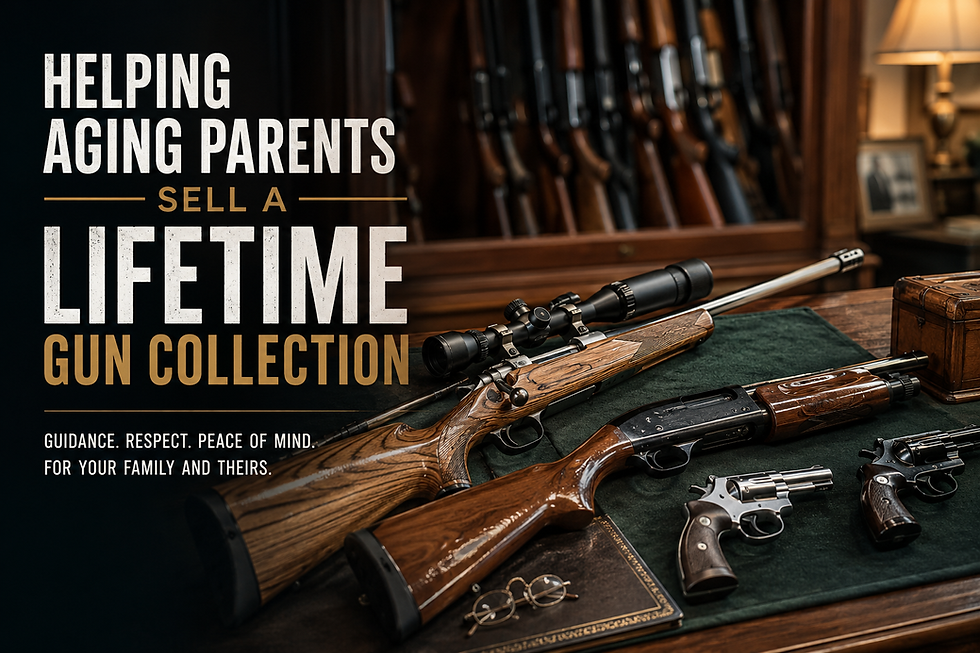
Recently, we met with a family in Chesterfield, Missouri, whose father had spent many years building a collection centered around hunting and precision rifles.

The collection reflected decades of experience and personal interests. Several rifles featured upgraded stocks, optics, and custom configurations. Like many long-time collectors, he knew the history behind each firearm and could explain how and why various pieces had been acquired.

At first glance, many family members see only "a room full of guns."
Collectors see something very different.
They see years of research, careful purchasing decisions, time spent at the range, hunting trips, friendships, and personal memories associated with the collection.
That difference in perspective is one reason these conversations can sometimes be emotional for both collectors and their families.
As retirement planning progressed, the family began discussing what made the most sense for the collection moving forward. The goal was not simply to sell firearms. The goal was to make informed decisions while the owner was still able to participate fully in the process.
What Adult Children Often Discover
This is one of the most common situations we encounter while helping adult children and families throughout the Saint Louis region. A parent may be downsizing, moving into assisted living or memory care, experiencing cognitive decline, or simply trying to make decisions about a firearm collection while they are still able to participate.
A firearm that looks similar to another may have significantly different value because of:
Condition
Original configuration
Custom features
Manufacturer variations
Historical significance
Current market demand
Accessories can also affect value.
Optics, original boxes, paperwork, spare magazines, slings, and other supporting items may contribute to overall worth.
Without understanding these details, families often struggle to determine what should be retained, gifted, appraised, auctioned, or sold.
Options for Families
Every family situation is different, but most collections ultimately fall into several categories.
Keep Certain Firearms
Many families choose to retain firearms that have sentimental value or are intended to remain within the family.
Having the collector identify those items before decisions need to be made later can simplify the process considerably.
Sell Selected Firearms
Some collectors decide to keep a core group of favorite firearms while selling duplicate, less-used, or lower-priority pieces.
This allows them to continue enjoying the hobby while reducing the size of the collection.
Sell the Entire Collection
In other situations, families decide that a complete liquidation is the most practical solution.
This approach often appeals to collectors who are simplifying during retirement, moving to a smaller residence, or simply reducing future responsibilities for their heirs.
Why Planning Ahead Matters
One of the greatest advantages of addressing a collection before it becomes part of an estate is that the collector can actively participate in the decision-making process.
Planning ahead also gives Missouri families the opportunity to organize documentation, discuss inheritance plans, and reduce uncertainty before legal or estate responsibilities arise.
The collector can:
Identify valuable firearms
Explain provenance and history
Locate documentation
Clarify family wishes
Determine which firearms should remain with heirs
Help establish realistic expectations regarding value

Without this information, surviving family members are often forced to make decisions with limited knowledge and significant uncertainty.
Signs It May Be Time to Start the Conversation
Families often begin discussing a firearm collection when:
Retirement is approaching
A move is being considered
A parent is moving into assisted living or memory care
Dementia, cognitive decline, or other health concerns are changing the family's circumstances
The collection has outgrown available storage
Children are unlikely to inherit the collection
Estate planning discussions are already underway
Starting the conversation early does not mean decisions must be made immediately.
It simply allows everyone involved to better understand the available options.
Frequently Asked Questions
Question: My dad has dementia. What should we do with his guns?
Answer: Every family's circumstances are different. If a parent is experiencing dementia or cognitive decline, the immediate priority is making sure firearms are safely secured and determining who has the legal authority to make decisions about them. Depending on the situation, the family may decide to keep certain firearms, transfer them to eligible family members, move them to appropriate secure storage, or sell some or all of the collection. Addressing the collection early can give families more options and, when appropriate, allow the owner to participate in those decisions.
Question: Should my parent appraise the collection before selling?
Answer: For larger collections or collections containing potentially valuable firearms, a professional evaluation can help establish realistic expectations and support informed decisions.
Question: What if none of the children want the firearms?
Answer: This situation is far more common than many collectors expect. Many families ultimately choose to sell all or part of a collection rather than transfer ownership to uninterested heirs.
Question: Is it better to handle the collection before an estate is opened?
Answer: In many cases, yes. When the collector is still actively involved, important information can be preserved and decisions can be made intentionally rather than under estate deadlines.
Question: Can an entire collection be sold at once?
Answer: Yes. Many collectors choose to liquidate a collection through a single transaction rather than pursuing individual sales.
Final Thoughts
A firearm collection often represents decades of effort, knowledge, and personal enjoyment.
For many families, the challenge is not simply determining what the collection is worth. The challenge is understanding how to handle it responsibly while respecting the wishes of the person who built it.
The families who experience the smoothest transitions are often the ones who begin the conversation before it becomes necessary.
By discussing the collection early, understanding available options, and involving the collector in the process, families can reduce uncertainty and make informed decisions that reflect both practical realities and personal priorities.
If you're helping an aging parent evaluate, downsize, or sell a firearm collection anywhere in the Saint Louis region, MDRF Enterprises can help your family understand the collection, explore available options, and develop a plan that reflects your goals and your parent's wishes.
Professional Note: This article is provided for educational purposes to help families, fiduciaries, and professionals better understand issues involving firearm collections. It is not intended as legal, tax, or financial advice. Because every estate and collection is unique, readers should consult qualified legal counsel or other appropriate professionals regarding their specific circumstances before making important decisions.


Comments